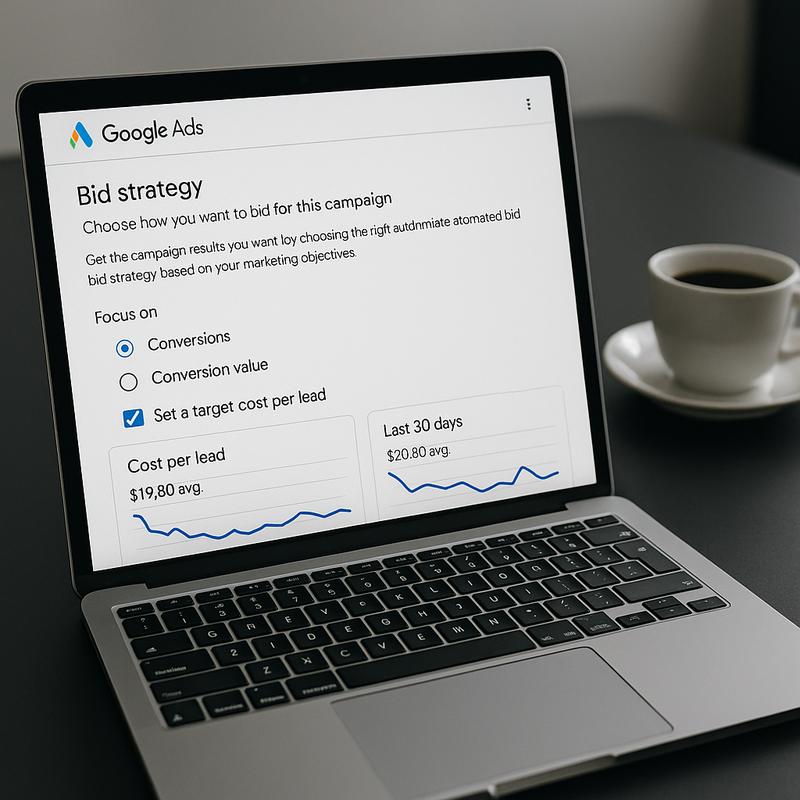
Most B2B advertisers focus on bid strategy and budget when their cost per lead climbs, but the more common culprit is a Quality Score problem they have never looked at directly. A keyword sitting at a Quality Score of 4 out of 10 can cost you 64% more per click than the same keyword at a score of 7, according to Google's own Ad Rank formula. That premium compounds across hundreds of clicks per month and quietly inflates your CPL without triggering any obvious alert in the dashboard.
What Quality Score Actually Measures in a B2B Context
Quality Score is a 1-10 rating assigned per keyword, based on three components: expected click-through rate, ad relevance, and landing page experience. Each component is rated as above average, average, or below average, and the combination determines your score. For B2B campaigns targeting long-tail, low-volume keywords like "enterprise document management software for healthcare," expected CTR benchmarks are lower by default, which means ad relevance and landing page experience carry proportionally more weight.
The practical consequence is that you cannot fix a Quality Score problem purely by adjusting bids. A higher bid might temporarily win more auctions, but Google's Ad Rank formula still penalises low Quality Score keywords with a higher cost-per-click floor. If your score is 3 and a competitor's is 7 on the same keyword, they can outrank you while paying less per click. This is documented in Google's Ad Rank and Quality Score documentation, and it applies to every B2B vertical from SaaS to professional services.
The Three Components and Where B2B Campaigns Typically Fail
Expected CTR is the component most B2B advertisers lose points on first. Campaigns structured around broad match or loosely themed ad groups generate impressions for queries that are only tangentially related to the ad copy, pushing CTR down. If your ad group contains 40 keywords but the ad headline only speaks to two of them, Google registers low expected CTR across the remaining 38. The fix is tighter ad group structure: single theme ad groups, or at most three to five tightly related keywords per group, with ad copy that mirrors the keyword's intent precisely.
Ad relevance failures are usually a sign of inherited campaign structure. Many B2B accounts we audit were set up with a small number of broad ad groups to keep management simple, with one or two generic ads serving the entire group. If your keyword is "cybersecurity compliance audit firms" and your headline reads "Enterprise Security Solutions," Google will rate that relevance as below average. Rewriting headlines to include the keyword phrase verbatim, or close variants, typically moves ad relevance from below average to average within one to two weeks of data accumulation. For a deeper look at how this connects to broader structural issues, see our guide on how to structure Google Ads for B2B.
Landing page experience is where B2B campaigns lose the most ground relative to consumer campaigns, because B2B landing pages are often long, jargon-heavy, and slow. Google evaluates page load speed, mobile usability, and the relevance of page content to the keyword that triggered the ad. A page that loads in 5.8 seconds on mobile and leads with generic brand copy will be rated below average on experience, regardless of how well-designed it looks on desktop.
Diagnosing Your Quality Score Breakdown by Component
In Google Ads, navigate to the Keywords view, click the columns icon, and add the three Quality Score component columns: expected CTR status, ad relevance status, and landing page experience status. Sort by impressions descending so you are looking at the keywords actually spending budget. Any keyword with two or more "below average" ratings is actively raising your CPL and should be prioritised for immediate remediation.
- Keywords with below average expected CTR: rebuild the ad group around tighter keyword themes and rewrite headlines to match search intent more precisely.
- Keywords with below average ad relevance: check whether the ad copy contains the keyword phrase or a close semantic match in the headline and description.
- Keywords with below average landing page experience: run the URL through Google PageSpeed Insights and check that the above-the-fold content directly addresses the keyword's intent.
- Keywords with all three ratings as below average: pause them immediately and rebuild from scratch with a dedicated ad group and a purpose-built landing page.
It is worth noting that Quality Score is a diagnostic signal, not a direct bidding input in real-time. The actual Ad Rank calculation uses the underlying data, not the displayed score. But keywords consistently rated at 3 or below on the visible scale almost always reflect genuine relevance and experience gaps that hurt your auction performance across every impression.
Landing Page Experience: The Fastest Lever to Pull
Of the three components, landing page experience tends to produce the fastest improvement once addressed, because it only requires changes on your own site rather than waiting for CTR data to accumulate. The two highest-impact changes are reducing page load time below 2.5 seconds on mobile and ensuring the H1 heading on the landing page reflects the keyword's intent closely. If your keyword is "managed IT services for law firms" and your landing page H1 says "IT Solutions for Business," Google's crawl will flag a relevance mismatch. Changing that H1 to "Managed IT Services for Law Firms" is a 10-minute fix that directly improves landing page experience rating. For a full breakdown of what else may be undermining your page, read our article on why your B2B landing page doesn't convert.
Page speed improvements require more effort but deliver compounding returns. Compressing images to WebP format, eliminating render-blocking scripts, and enabling browser caching typically reduce load time by 1.5 to 2.5 seconds without a full rebuild. A landing page that moves from a 5-second load to a 2.2-second load will usually shift its landing page experience rating from below average to average within two to three weeks of Google re-crawling it.
Connecting Quality Score to Cost Per Lead in Practice
The relationship between Quality Score and CPL is not linear, but the directional impact is consistent. Based on widely cited analysis of Google's Ad Rank multipliers, moving a keyword from a Quality Score of 5 to 7 reduces effective CPC by approximately 16%, and from 5 to 9 by approximately 44%. On a B2B campaign spending $8,000 per month with an average CPC of $12, a portfolio-wide Quality Score improvement from 5 to 7 could reduce that CPC to roughly $10, freeing up around $1,300 in monthly budget without touching spend levels. That is not a marginal gain on a mid-market B2B account.
The CPL impact compounds because lower CPC means more clicks from the same budget, which increases the pool of visitors reaching your landing page. If your conversion rate holds steady at 4%, 667 monthly clicks becomes 800 clicks, producing 32 leads instead of 26 from identical spend. This is why Quality Score optimisation should come before any conversation about increasing budget. Spending more on a low Quality Score account is one of the most common reasons Google Ads fail to generate quality leads at scale in B2B.
Tracking the downstream impact accurately requires proper attribution. If you are not connecting Quality Score improvements to pipeline outcomes, you are optimising in the dark. A solid multi-touch attribution model lets you verify whether the leads gained from CPL reduction are actually converting into revenue, not just inflating top-of-funnel numbers.
A Practical Remediation Schedule
Quality Score improvements do not happen overnight. Google needs 200 to 400 impressions on a keyword before its expected CTR component stabilises, which means changes to ad copy take one to three weeks to register on low-volume B2B keywords. Prioritise the highest-spend, lowest-scoring keywords first, implement landing page and ad copy fixes simultaneously, and review component ratings every two weeks rather than daily. Set a baseline export of your Quality Score components before starting so you have a clean before-and-after comparison after 30 days.
One structural change that accelerates improvement across the whole account is consolidating underperforming ad groups into tighter single-theme groups and pausing any keyword with fewer than 50 impressions in the last 90 days. Low-impression keywords drag on expected CTR averages and rarely justify the ad group complexity they introduce. Keeping your active keyword list lean and well-matched to specific landing pages is the single highest-leverage habit for maintaining Quality Scores above 7 across a mature B2B account.