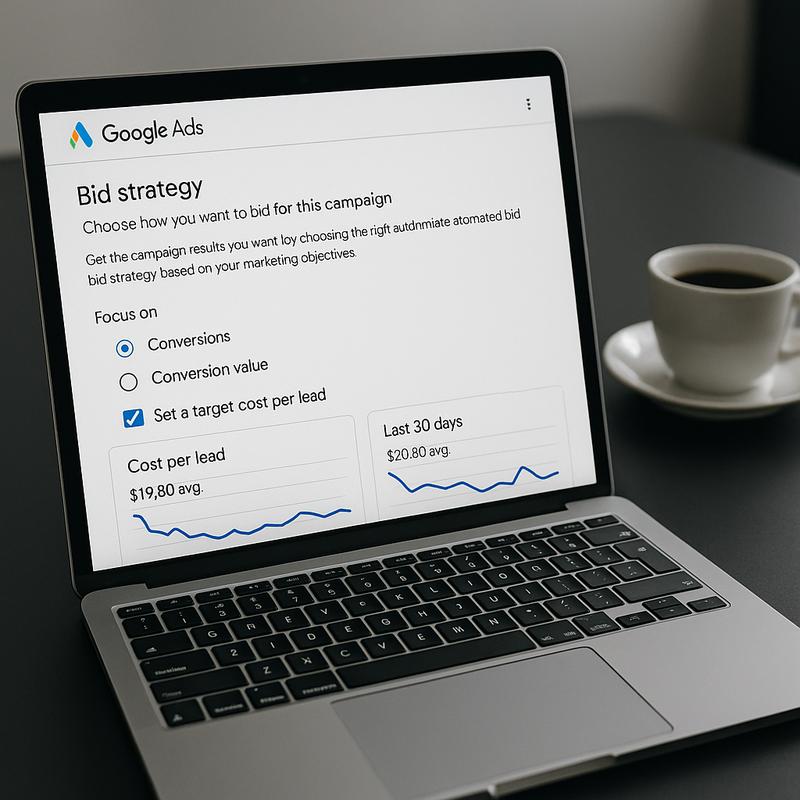
Most B2B Google Ads accounts we audit have the same blind spot: the team switched to an automated bid strategy, CPL stayed stable, and everyone assumed things were working. What they missed is that Maximize Conversions and Target CPA optimize for conversion volume, not conversion quality, and in B2B those two things are rarely the same thing.
Why Automated Bidding Defaults Hurt B2B Accounts
Google's smart bidding algorithms are trained to get you more of whatever conversion action you're feeding them. If that action is a form fill, the algorithm will find every searcher likely to fill a form, including students researching for essays, competitors scouting your pricing, and job seekers who landed on the wrong page. For B2B companies targeting mid-market or enterprise buyers, this is a serious problem because the signal volume is already low and noisy leads pollute the model fast.
The fix is not to abandon automated bidding entirely. It's to feed it better signals. Accounts that pass a qualified-lead value back to Google via offline conversion imports consistently see a 20-35% improvement in downstream pipeline quality compared to accounts optimizing on raw form fills. Google's own documentation on offline conversion tracking explains how to set this up using the GCLID parameter, and it works across both Search and Performance Max campaigns.
The second structural issue is learning period disruption. Smart bidding needs roughly 30-50 conversions per month per campaign to stabilize. Most B2B campaigns with average deal sizes above $10k generate 8-15 conversions per month per campaign, which means the algorithm never exits the learning phase and your CPL oscillates wildly. Consolidating campaigns and using a shorter conversion window (7-day click instead of 30-day) often resolves this without changing targeting.
The Target CPA Trap in Low-Volume B2B Campaigns
Setting a Target CPA that's too aggressive is the single most common mistake we see in B2B Google Ads accounts. If your historical CPL is $180 and you set a tCPA of $90 to hit a budget goal, the algorithm will restrict impressions to only the highest-intent queries, which sounds good in theory. In practice, it reduces volume so sharply that the campaign loses statistical significance and Google starts making bidding decisions based on 3-4 conversions per week, none of which may represent your actual ICP.
A safer starting point is to set your tCPA at 110-120% of your actual recent CPL and let the algorithm find its floor over 4-6 weeks before tightening. This approach, combined with solid negative keyword exclusions to cut irrelevant traffic, typically reduces wasted spend by 15-25% without the lead volume cliff that comes from an over-restricted tCPA.
Maximize Conversion Value Requires Proper Value Rules
If you're running Maximize Conversion Value or Target ROAS, you need to assign differentiated values to your conversion actions. Most B2B advertisers assign the same flat value to every form fill regardless of which product line, region, or company size the lead represents. This tells the algorithm that a demo request from a 5-person startup and a contact form from a Fortune 500 procurement team are worth exactly the same amount, which produces predictably poor results.
The correct approach is to create conversion value rules that adjust the reported value based on signals like device, location, or audience list membership. For example, if you have a remarketing audience of site visitors who viewed your enterprise pricing page, you can apply a 3x value multiplier to conversions from that audience. This gives the algorithm a reason to bid more aggressively on high-fit traffic without you manually adjusting bids.
This is closely related to how you structure the account overall. If campaigns are split by product line or customer segment, value differentiation becomes far more precise. Our guide on how to structure Google Ads for B2B covers the campaign architecture decisions that make bid strategy work correctly downstream.
Portfolio Bid Strategies for Multi-Campaign B2B Accounts
Once an account has more than three active search campaigns targeting related audiences, portfolio bid strategies start to outperform individual campaign-level strategies. A portfolio tCPA pools conversion data across all included campaigns, which solves the low-volume learning problem described earlier. An account with five campaigns each generating 10 conversions per month now has 50 conversions feeding one shared model, which is enough for stable optimization.
The caveat is that portfolio strategies require all included campaigns to share the same business objective. Mixing a brand campaign (CPL of $30) with a competitor campaign (CPL of $220) inside one portfolio will cause the algorithm to over-invest in brand traffic because it's cheaper, which is not the same as being more valuable. Segment portfolios by intent tier: brand, non-brand high-intent, and competitor, each with its own tCPA target reflecting what those leads are actually worth.
What to Check Before Changing Your Bid Strategy
Before switching strategies, run a diagnostic on your current conversion data quality. Check whether your conversion actions are counting duplicate form submissions, whether the tracking fires on confirmation pages only (not on form interaction), and whether any conversions are being imported from CRM with a delay that distorts the bidding model's recency signals. We regularly find accounts where 30-40% of recorded conversions are duplicates or test events that were never filtered out.
- Audit all active conversion actions and pause any that are not tied to a qualified lead or pipeline step
- Confirm offline conversion imports are running with a lag of no more than 14 days to stay within the attribution window
- Check that auto-tagging is enabled so GCLIDs are passed correctly to your CRM
- Review your conversion window settings relative to your actual sales cycle length
- Set up value rules for at least two audience segments before enabling Maximize Conversion Value
Once the data hygiene issues are resolved, bid strategy changes produce reliable results quickly. In one account we managed for a SaaS vendor in the UAE, fixing duplicate conversion tracking and switching from Maximize Conversions to a portfolio tCPA reduced CPL by 31% in six weeks while keeping lead volume flat. The algorithm simply had cleaner data to work with. For more context on how lead quality problems manifest before you even reach the bid strategy layer, see our breakdown of why Google Ads campaigns fail to generate quality leads.
The Attribution Layer You Cannot Ignore
Bid strategy decisions and attribution model decisions are tightly coupled. If you're running data-driven attribution (which Google now defaults to for most accounts), the algorithm distributes conversion credit across multiple touchpoints in a session. For B2B buyers who research over days or weeks, this often means clicks from upper-funnel queries receive partial credit, which encourages the bidding model to bid on broader terms than you actually want.
Switching to last-click attribution for your primary conversion actions gives you a more conservative, intent-focused signal that aligns better with B2B purchasing behavior. It's not theoretically perfect, but it reduces the algorithm's incentive to chase awareness clicks. Pairing this with a multi-touch attribution model tracked separately in your CRM gives you both the bidding precision you need and the full funnel visibility your CFO will ask about at the quarterly review.