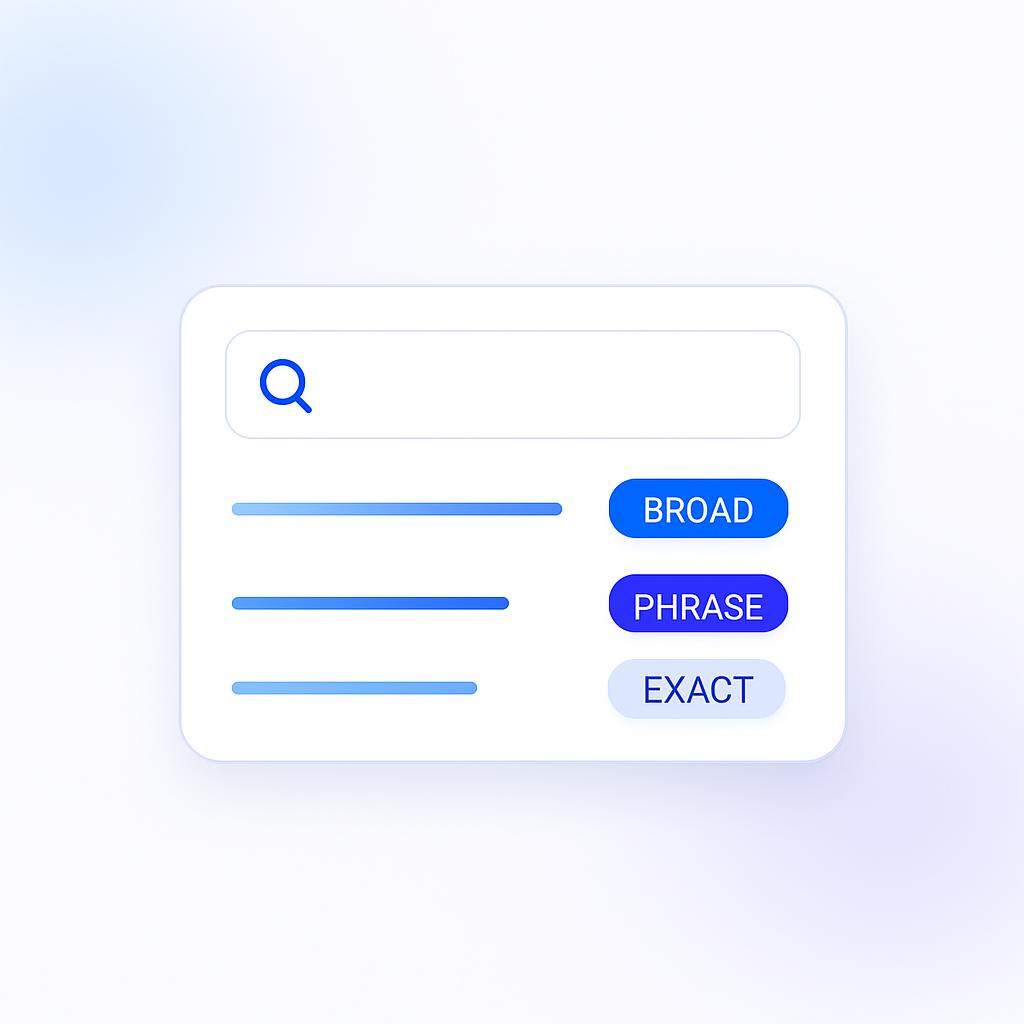
Match type decisions are one of the most consequential settings in any Google Ads account, but most B2B teams treat them as a one-time setup choice rather than an active lever. In B2B, where a single unqualified lead wastes an hour of a sales rep's time and distorts your pipeline data, the cost of the wrong match type strategy compounds fast. This article covers exactly how to structure match types for B2B campaigns in 2026, including where broad match still earns its place and where it consistently destroys CPL.
Why B2B Match Type Errors Are More Expensive Than in B2C
In B2C, a bad click costs you a few dollars and a bounce. In B2B, a bad click can cost you $80-$400 in CPL (typical range for mid-market SaaS and professional services), plus the downstream cost of a sales team following up on a lead that was never a buyer. Google's own data shows that broad match now interprets intent more aggressively than ever, matching queries that share a 'theme' with your keyword even if those queries contain none of your actual words. For B2B advertisers targeting specific job titles, industries, or software categories, that latitude is dangerous by default.
The other compounding factor is conversion volume. B2B accounts rarely generate enough conversions per keyword to fully train Smart Bidding, which means broad match combined with Target CPA or Target ROAS often enters a self-reinforcing loop: it finds cheap conversions (frequently lower-quality leads), the algorithm learns those patterns, and CPL appears to improve while lead quality quietly collapses. This is a primary reason why bid strategy mistakes inflate B2B CPL in ways that take months to diagnose.
The 2026 Match Type Reality: What Google Changed
Broad match modifier was retired in 2022, and by 2026 phrase match has continued to expand its reach closer to what BMM used to cover. Google's official match type documentation confirms that phrase match now allows additional words before or after your phrase and accounts for close variants including misspellings, synonyms, and related searches. In practice, this means phrase match in 2026 is generous enough that it often makes broad match redundant for most B2B use cases. Exact match still enforces tight control but also includes close variants, so 'ERP software for manufacturers' can trigger 'ERP systems manufacturers' even under exact match settings.
The critical shift for B2B is that keyword consolidation pressure from Google has pushed many accounts into fewer, broader ad groups. Resist this for high-value, high-intent keywords. Keeping exact match and phrase match in separate campaigns with separate budgets gives you conversion data you can actually trust, rather than an averaged signal that hides which match type is driving quality.
A Practical Match Type Structure for B2B Campaigns
The structure that consistently works for B2B accounts with monthly budgets between $5,000 and $50,000 is a two-tier approach. Tier one uses exact match on your highest-intent, highest-converting keywords, with tight negative keyword lists and a manual or enhanced CPC bid strategy until you have at least 30 conversions per month per campaign. Tier two uses phrase match on supporting keywords, with a dedicated budget cap and its own negative list that excludes all exact match terms, preventing internal query overlap and keeping your data clean.
Broad match, if used at all, belongs in a separate prospecting campaign with its own capped daily budget (typically 10-15% of total spend) and a robust audience signal layer using your CRM customer list or website visitor segments. Without that audience constraint, broad match in B2B routinely pulls in job seekers, students, and SMBs well below your ICP threshold. Treating it as a controlled experiment rather than a default setting is the difference between useful discovery and wasted budget.
- Exact match: core high-intent terms, separate campaign, lowest CPL targets, priority budget
- Phrase match: supporting and lateral intent terms, mid-budget allocation, review SQR weekly
- Broad match: prospecting only, audience-layered, capped spend, evaluated on lead quality not volume
- Negative keywords: build a shared list at account level and supplement with campaign-level exclusions
- Search query reports: review every 7 days minimum, add negatives before they cost more than one conversion
Negative Keywords Are the Other Half of Match Type Control
A match type strategy without a rigorous negative keyword process is incomplete. For B2B accounts, the highest-ROI negatives fall into three categories: consumer-intent modifiers ('free', 'cheap', 'DIY', 'how to'), job-seeker signals ('salary', 'jobs', 'careers', 'internship'), and irrelevant verticals that share your terminology but serve a completely different buyer. A logistics software company, for example, will often trigger on 'supply chain management degree' or 'logistics coordinator resume' under broad or phrase match unless those terms are explicitly excluded. For a deeper look at building this system, see our guide on cutting wasted ad spend with negative keywords.
One structural mistake many B2B accounts make is maintaining negatives only at the campaign level. An account-level shared negative list ensures that as new campaigns are added, foundational exclusions carry over automatically. This is especially important for agencies managing multi-product B2B accounts where new campaigns are launched regularly and a missed negative can silently drain budget for weeks before anyone notices.
When to Loosen Match Types and When to Tighten Them
There are legitimate reasons to allow broader match reach in B2B. If you are entering a new geography or a new product category with no historical search data, phrase match gives you signal without the risk of extreme reach. If your exact match campaigns are impression-constrained (impression share below 60% with a budget that should support more), loosening to phrase match recovers lost reach without a full rebuild. And if your current keyword list is performing well and you want to discover adjacent buyer queries you may have missed, a controlled broad match prospecting campaign is a structured way to surface them.
The trigger to tighten is almost always lead quality degradation. If your audience segmentation in Google Ads shows that leads from certain campaigns have lower SQL conversion rates, longer sales cycles, or systematically wrong company sizes, the first diagnostic step is to pull the search query report and check which match types are generating those queries. In most cases, phrase or broad match is pulling in off-ICP searches that look like conversions but are not buyers. Tightening match type, rather than adjusting bids or landing pages, resolves the root cause faster.
Structuring for Scale Without Losing Quality
As B2B Google Ads accounts scale past $20,000 per month, the temptation is to consolidate campaigns, trust Smart Bidding, and let broad match do the exploration work. This approach works in high-volume B2C but regularly breaks in B2B because the conversion signals are too sparse to train the algorithm on quality. A more reliable path to scale is to expand phrase match coverage into new product lines or buyer segments while keeping exact match campaigns stable and protecting their budget. Our B2B paid search management practice structures accounts this way by default, keeping performance visibility high as spend grows.
The practical benchmark to aim for before expanding match type reach is 50 or more tracked conversions per month at the campaign level. Below that threshold, Smart Bidding is working with too little data, and broader match types will find reach by optimising for signals that do not correlate with deal quality. Above that threshold, the algorithm has enough to work with, and phrase or broad match expansion with an audience layer becomes a reliable growth tactic rather than a gamble.